It is very normal for children and young people to have specific fears throughout their childhood and adolescence. Usually, these fears and worries go away on their own as you get older and expand your experience. Anxiety is the feeling we get as part of the normal human response to danger.
The danger does not have to be real or happening in the present moment, it can be worries or fear thoughts, images or memories; but our body reacts as if the danger is actually happening or is going to happen.
We say we are ‘anxious’ or have ‘anxiety’ when our body automatically goes into the threat/self-protection reaction, which can sometimes be very strong and overwhelming. The body’s threat/self-protection reaction is commonly called the ‘fight/flight/freeze’ reaction, which is driven by the need for survival and safety. This reaction helps us to survive in the face of a real and present danger. It is also activated by fears, images or memories, some of which we are aware of and others are not so clear, we just notice the anxiety in our body.
It is very normal for children and young people to have specific fears throughout their childhood and adolescence. These fears are often related to becoming more aware of the environment and potential dangers, such as heights, the dark or 'monsters under the bed'. Usually, fears and worries go away on their own as children develop and expand their experiences. Our body reacts as if the danger is actually happening or is going to happen. It works on a better safe than sorry principle - better to activate fight/flight and be wrong (survive), than to not activate it and be wrong (don't survive).
Make mindfulness your superpower
Mindfulness is the basic human ability to be fully present, aware of where we are and what we’re doing, and not overly reactive or overwhelmed by what’s going on around us. Here are two videos on why mindfulness empowers us:
How to manage anxiety and Top Tips
To manage anxiety, the first thing to do is to notice the change in the body and then focus on calming the body’s threat self-protection reaction using these simple strategies:
BREATHE: Breathe in for a slow count of 4 and breathe out for a slow count of 6.
COME to YOUR SENSES: find and focus on:
5 things you can see
4 things you can hear
3 things you can touch
2 things you can smell
1 slow, deep breath
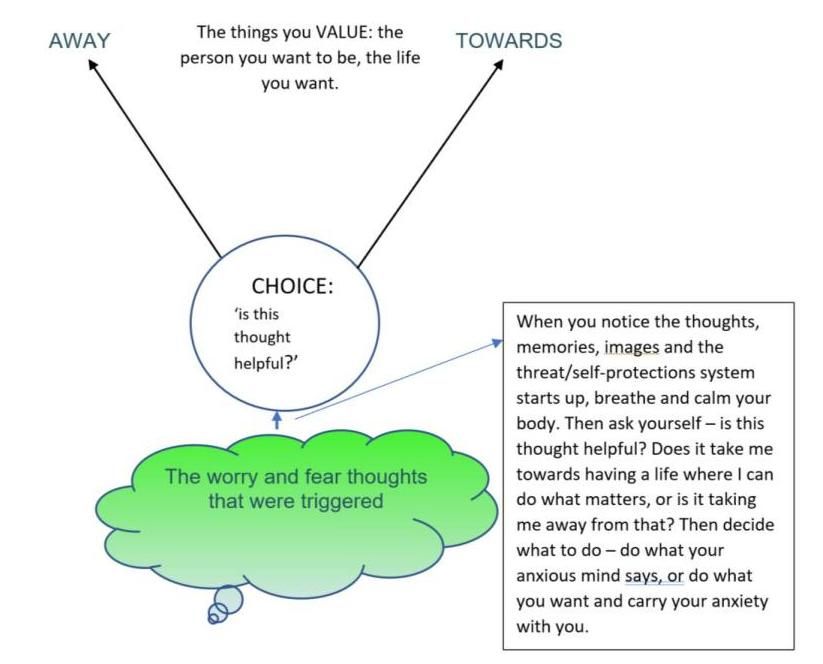
When you feel calmer CHOOSE: whether the thought/s is helpful or unhelpful.
Top Tips
Worries and anxiety are normal; everyone worries so it’s important to remember you are not alone. Some worries may seem very real and very scary. Tell someone how you are feeling no matter what your worries are, even if you are worried about doing so. There will be someone who will listen and try to support you.
lthough anxiety feels horrible, remember these feelings will pass and the physical sensations cannot harm you. Remind yourself that you have been anxious before, that those feelings passed, that you coped and were ok. If you need to, breathe in slowly for a count of 4, and out slowly for a count of 6. Use the ‘Come to your senses’ exercise above.
Expand your comfort zone and by discovering what you can do (even when your anxious mind says you can’t).
PAUSE: when you notice sensations of anxiety - PAUSE
ANCHOR: yourself to the present moment and BREATHE to help calm your body
UNDERSTAND: anxiety is normal, and is an old system of helping you survive.
STEP BACK: take a different perspective and ask if your mind is being helpful? Is it taking you towards doing what matters to you, or away from that?
ENGAGE: in taking action and doing what matters, carrying your anxiety with you if you need to.
The below Red, Amber, Green accordions highlight different levels (Red being the most serious) of anxiety and what should be done.
Type and nature of worry
It is normal for children and young people to experience worry as they develop through childhood and adolescence. The typical worries children and young people experience tend to be situation specific, short term and can be managed by yourself or with the support of parents/carers. Examples might be:
Being away from home/ parent
Going to school (but settling)
Worrying about going to bed/ the dark
Worry about something bad happening themselves or to a loved one
Doing new things
Going to unfamiliar places
Doing things independently
Public speaking/ performing
Tests and exams
Change and uncertainty (e.g., family breakdown or conflict)
In response to an upsetting event such as being bullied
Being in social situations
You might feel the following:
Not wanting to be separated from a loved one
Not wanting to be left alone
Seeking verbal reassurance and checking things are ok
Not wanting to go to school
Avoidance of what they are fearful of
Having bad dreams/ mild sleep disturbance
Having some physical symptoms such as feeling sick, hot and clammy, tummy aches
Feeling restless and fidgeting
Appearing unsettled, distracted or irritable
May appear more challenging or oppositional/ argumentative
Thinking or talking a lot about their worry
Crying or becoming distressed
Things to try, support and next steps
Normalise that anxiety is a natural emotion, the physical sensations of anxiety can be unpleasant but it’s ok, it will pass and won’t cause any harm
Don't avoid social situations; the more you avoid them the harder it becomes and the more anxious you will become. Instead, develop courage by doing what they are afraid of, which gets easier each time.
Develop an anxiety ladder – start at the first rung with a relatively easy challenge, and increase the challenges. Challenges can be broken down into many rungs of needed.
Talk to a friend and to a parent / carer about how you are feeling. Get them to watch the workshop on Coping and Resilience Skills. They should be role modelling that you can do things even when you’re anxious and should be supporting you to problem solve any real issues
Useful Resources:
Under 12s – Parent/carer lead interventions:
Helping Your Child With Fears and Worries, by Cathy Creswell and Lucy Willetts
Love in, Love out: A compassionate approach to parenting your anxious child, by Malie Coyne
Success Club empowers and challenges under achieving young people to fulfil their social, personal and academic potential
Over 12s – young person self-help with support from parent/carer
Stuff That Sucks, by Ben Sedley
Your Life, Your Way, by Joseph Ciarrochi and Louise Hayes
Success Club empowers and challenges under achieving young people to fulfil their social, personal and academic potential
Little Blue book of sunshine - a mental health booklet that has been developed for children and young people living in Hampshire, Southampton and the Isle of Wight. The book aims to help children and young people by sharing tips on how to deal with many problems, such as anxiety, body image, relationships and anger. Click here to access the PDF or access the booklet via Apple Books or Google Play Books.
Young people: 16+
Stuff That Sucks, by Ben Sedley
Your Life, Your Way, by Joseph Ciarrochi and Louise Hayes
The Worry Trick, by David A. Carbonell
Things Might Go Terribly, Horribly Wrong: A Guide to Life Liberated from Anxiety, by Kelly Wilson
You need some help: These are challenges that some young people experience and may need some support with.
Type and nature of worry
The degree to which a young person believes their thoughts as accurate truth or predictions can make anxiety worse. Episodes of anxiety might be more frequent or prolonged, cause significant distress and have a mild impact on their ability to cope with everyday life such as going to or coping at school, seeing friends or taking part in leisure activities. Examples might be:
Fears that something bad might happen to themselves or someone else
Worry about not coping
Worry about performance in exams or the future
Worries related to being habitually bullied or experiencing regular conflict or distress either at home or school
Worries about what others might think, say or do
Worries about negative judgements by others or social rejection/ exclusion
You may experience the following:
As well as the features in Green, the following might also be present:
Disrupted sleep (difficulties getting to or staying asleep, nightmares/ night terrors)
Persistent reassurance seeking
Increased avoidance of doing things
Becoming very distressed or agitated when triggered by a situation or thinking about a situation
Some repeated patterns of behaviour or routines which seem to help you but don’t make sense to others (e.g., repeated checking or counting)
Panic - such as getting distressed, racing heart rate, quicker breathing, upset tummy, feeling sick, feeling dizzy or faint
Requesting things be done in certain ways or requesting others to do things for them
Your family might also find themselves struggling to do things as they normally would as they may make adjustments to accommodate how you are feeling or responding
Things to try, support and Next Steps
As well as the steps in Green the following might be helpful:
Speak to your parent / carer - it is really important that they know how you are feeling. Also speak to a friend - just by listening, they can often help.
Kooth is a free online counselling and emotional wellbeing support service offered to young people aged 11 - 25 years (up to their 26th birthday) living in Dorset, Hampshire and the IoW with a safe and secure means of accessing support with their emotional and mental health needs from a professional team of qualified counsellors.
No referral is required, you can access the service directly and in complete confidence at www.kooth.com.
Further self-help resources (podcasts, videos, downloads etc) can be found via the links below
You can also share your concerns with your school mental health support team or school nurses or consider accessing help from a local counselling service
If you live in Hampshire or on the Isle of Wight, the NHS 111 mental health triage service can provides advice, support and guidance, 24 hours a day, seven days a week. The Mental Health Triage Team has a wide range of skills, including on the phone brief psychological support and has access to key services and organisations that can offer mental health support to you and your child in your time of need. Just dial 111 or online at www.111.nhs.uk.
Useful Resources:
Under 12s – Parent/carer lead interventions:
Helping Your Child With Fears and Worries, by Cathy Creswell and Lucy Willetts
Love in, Love out: A compassionate approach to parenting your anxious child, by Malie Coyne
Success Club empowers and challenges under achieving young people to fulfil their social, personal and academic potential
Over 12s – young person self-help with support from parent/carer
Stuff That Sucks, by Ben Sedley
Your Life, Your Way, by Joseph Ciarrochi and Louise Hayes
The Anxiety Workbook For Teens, by Lisa Schab
Success Club empowers and challenges under achieving young people to fulfil their social, personal and academic potential
Little Blue book of sunshine: a mental health booklet that has been developed for children and young people living in Hampshire, Southampton and the Isle of Wight. The book aims to help children and young people by sharing tips on how to deal with many problems, such as anxiety, body image, relationships and anger. Click here to access the PDF or access the booklet via Apple Books or Google Play Books.
Young people: 16+
Stuff That Sucks, by Ben Sedley
Your Life, Your Way, by Joseph Ciarrochi and Louise Hayes
The Worry Trick, by David A. Carbonell
Things Might Go Terribly, Horribly Wrong: A Guide to Life Liberated from Anxiety, by Kelly Wilson
You might need specialist treatment: These are difficulties that cause a significant impact and a young person may need specialist support.
Type and nature of worry
These anxieties are severe and enduring. These cause significant distress to a young person and significantly disrupt daily life such as school/ college, socialising and even self-care activities (e.g., sleep, bathing, eating).
Despite fully engaging with the strategies outlined in the green and amber stages, you may still be experiencing overwhelming anxiety that is significantly disrupting your daily life.
Strong, unwavering beliefs that something bad might happen or that there is danger
Persistent, intense and overwhelming “What if” thoughts that are seen as accurate predictions or truths.
You may experience the following:
As well as the features in Green and Amber, the following might also be present:
Repeated routines or rituals that impact on your day such as being on time for or coping at school, being able to socialise and engage in hobbies or interests, being able to get up or go to sleep.
Persistent refusal to leave the house or attend/ take part in activities such as school, hobbies, interests, seeing friends.
Significant impact on health and wellbeing such as not sleeping or eating for a sustained period of time. You may even show signs of physical compromise (ill health) as a result of this.
Withdrawn and uncommunicative or not wanting to be left alone at all
Frequent episodes of panic that may include, feeling dizzy, faint or vomiting.
Thoughts and beliefs are rigid (e.g., 100% belief that something bad will happen).
Becoming agitated, distressed, oppositional or aggressive towards others when anxious.
Reactive and impulsive behaviour such as running away, which may place them or others in danger.
Your families might find themselves struggling to do things as they normally would; family functioning is disrupted and they are required to make significant adjustments to accommodate how you are feeling or responding
Things to try, support and Next Steps
As well as the steps in Green and Amber the following might be helpful:
Speak to your parent / carer - it is really important that they knwo how you are feeling
Speak to your GP. If you live in Hampshire or on the Isle of Wight, the NHS 111 mental health triage service can provides advice, support and guidance, 24 hours a day, seven days a week. The Mental Health Triage Team has a wide range of skills, including on the phone brief psychological support and has access to key services and organisations that can offer mental health support to you and your child in your time of need. Just dial 111 or online at www.111.nhs.uk.
Speak to your school mental health support team or school nursing team.
Kooth is a free online counselling and emotional wellbeing support service offered to young people aged 11 - 25 years (up to their 26th birthday) living in Dorset, Hampshire and the IoW with a safe and secure means of accessing support with their emotional and mental health needs from a professional team of qualified counsellors.
Consider making a self-referral to a CAMH Service in your area.
Useful Resources:
Under 12s – Parent/carer lead interventions:
Helping Your Child With Fears and Worries, by Cathy Creswell and Lucy Willetts
Love in, Love out: A compassionate approach to parenting your anxious child, by Malie Coyne
Success Club empowers and challenges under achieving young people to fulfil their social, personal and academic potential
Over 12s – young person self-help with support from parent/carer
Stuff That Sucks, by Ben Sedley
Your Life, Your Way, by Joseph Ciarrochi and Louise Hayes
The Anxiety Workbook For Teens, by Lisa Schab
What To Do When You Worry Too Much, by Dawn Huebner
The ACT workbook for teens with OCD, by Patricia Zurita
Success Club empowers and challenges under achieving young people to fulfil their social, personal and academic potential
Young people: 16+
Stuff That Sucks, by Ben Sedley
Your Life, Your Way, by Joseph Ciarrochi and Louise Hayes
The Anxiety Workbook For Teens, by Lisa Schab
What To Do When You Worry Too Much, by Dawn Huebner
The ACT workbook for teens with OCD, by Patricia Zurita
The Worry Trick, by David A. Carbonell
Things Might Go Terribly, Horribly Wrong: A Guide to Life Liberated from Anxiety, by Kelly Wilson